
Grief begins with love: Sarah and Reena’s story
Before there is loss, there is a person who changes your world: a shared life, private jokes, routines that become second nature, and the quiet certainty of having found your person. And, when that person dies, grief is not simply the absence they leave behind. It is the reshaping of everyday life around that absence.
In this series, we are sharing the powerful stories of widowed members of our community, listening not only to how they have lived with loss, but to the relationships that came before it. Because every grief story is also a love story.
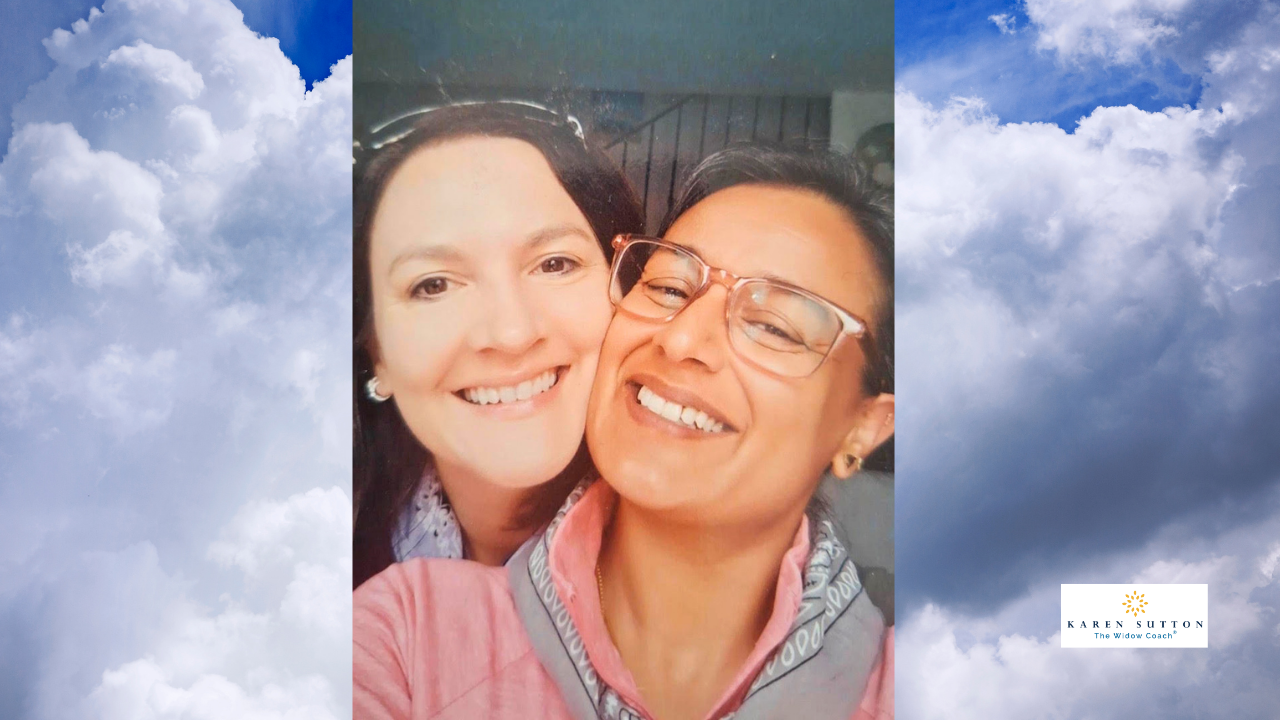
In this first piece, Sarah reflects on her life with her beloved Reena, the memories that still bring her close, and what it has meant to navigate widowhood as a woman grieving her same-sex partner. Her story is one of profound loss, enduring love and the importance of being truly seen in grief.
Where it all started
Before understanding the depth of a loss, I think it’s so important to understand the love that came before it. Grief is not simply a response to someone no longer being here; it is a reflection of the bond, the connection, and the life that was shared. I therefore first asked Sarah how she and Reena found each other, what first drew them together, and how she would describe the relationship they built.
I met my lovely Reena at work – we just clicked instantly, I think we got the giggles in an important meeting in the first week we worked together, and became best friends straight away. She is the most incredible person – wickedly funny, deeply kind, super smart and completely adorable. She just had this aura that drew you in. I’m constantly grateful and astonished that I got to marry the best person I’ve ever known.
The details we hold on to
When we lose someone, it is often the small things that stay with us: the habits, places, routines and moments that belonged only to us. The way they made a cup of tea, the sound of their footsteps in the hallway or the messages they sent during the day. These ordinary moments, once woven so naturally into everyday life, can become some of the most extraordinary reminders of the person we love. I asked Sarah about the memories of her life with Reena that she returns to most often and what made Reena so uniquely herself.
From the beginning, we were each other’s calm place. We used to run away to quiet places in nature, just to walk in the woods or step in the sea. Our favourite thing was getting lost in the middle of nowhere, but we always felt like home together. We hated being apart, and I will always cherish the ‘small’ moments of holding hands on the sofa watching telly, or her taking me out for a cheeky McDonald’s breakfast on a Sunday morning. I am so lucky to have so many smiley memories. Reena was always better with words than me, and always told me how much she loved me, and what she loved about me too. Her nicknames for me were ‘Neo’ (because I’m her ‘one’), ‘My everything’. ‘Beautiful heart’, ‘Compass’ and ‘Wifey pooh’. How could I not adore someone who made me feel that special every second of every day?
Being seen, being loved
Every relationship exists within a wider world. The people around us, our families, cultures, communities, beliefs, life experiences and the circumstances we live in all shape how we experience love - and, when that love is lost, how we experience grief. For same-sex couples, that experience can sometimes include questions of visibility, acceptance and recognition. I asked Sarah what it was like to build a life with Reena in the communities and spaces around them, and whether their relationship felt seen and celebrated.
Being a same-sex couple does mean we occasionally experienced a tut or two on the bus or in public places if we were a little too tactile – for instance, we never felt we could just hold hands in public, just in case we got the disapproving comment, but for the most part, it didn’t feel like a big deal. Both our families were supportive, I think because they could see how we treated each other and cared about each other.
The reality of grief
Grief isn't experienced only in life's biggest moments. More often than not, it reveals itself in the ordinary rhythm of everyday life. It appears in the pause before setting an extra place at the table, in reaching for the phone to share a piece of news before remembering there is no one on the other end, or in hearing a familiar song unexpectedly while out shopping. I therefore wanted to ask Sarah what life has felt like since losing Reena - not just the enormity of it but how grief has found its place in her daily world.
Losing Reena was a huge shock - to be honest it’s hard to find the right words to describe the pain of it, the ache in your heart because you just want to see them smile at you, but I’ll try. It was quick and unexpected, and I struggled to function if I’m being truthful. I fortunately have an amazing support system, which makes a profound difference (this includes my two cats by the way).
But the physicality of the pain was unexpected to me, how it sits in your bones. Every day when I woke up for the first couple of months, I felt like life’s punching bag – every memory (happy or sad), every thought, image, felt like a punch in the heart. I learnt pretty quickly, it was best to just take those punches, and not resist them. My heart felt so broken, I didn’t understand how it was still beating.
It’s been over a year now, and I am able to welcome in the glimmers so much more (and smile at memories! What a gift that is) – Karen’s retreat was truly a reset for me that has made such a huge difference. I particularly struggled with the guilt – I don’t know why guilt rears its ugly head when you go through grief, but it’s an angry little demon, and it’s not even real! I know Reena would tell me there’s nothing to feel guilty about, she knows how much I love and adore her. Karen’s retreat helped me to recognise that.
Finding space for loss
For many widowed people, community can be a source of comfort and understanding. It can be reassuring to be among others who instinctively understand the profound impact of losing a partner, without needing every emotion or experience to be explained. Yet, at the same time, grief is deeply personal, and no two journeys look exactly alike. While being in a community can feel incredibly supportive, not every experience of widowhood is always recognised or understood in the same way. I asked Sarah whether she felt that her loss has been truly understood within widowhood spaces or whether there have been moments where she felt her experience went unrecognised.
Through Karen’s Widow Retreat at Tofte, I have had the privilege to meet the most wonderful, kind, funny, brave group of ladies. I am so grateful for every single one of them. At no point did I ever feel different, or not accepted. I know that when I was driving to the retreat, there was a little part of me that was a little worried, but I reckon we all felt anxious in different ways, because you don’t know what to expect, you just know you want to do something to help yourself.
And losing your person makes you brave in ways you can’t really describe. People in my life have told me many times to ‘stay strong’ and I always want to say, I’m not strong, I am the weakest I’ve ever felt. But brave? Absolutely, I will own that one!
And through Karen’s retreat/Finding Hope, I have also had the privilege to be connected with other widows in my local area too, who are all wonderful. I will also give a shout out to Widowed and Young – this charity supports men and women who have lost their person before the age of 50. They are very welcoming too, and have lots of different resources and sub-groups which can be helpful.
What sustains us
No one navigates grief entirely alone. Yes, there are parts of grieving that are inevitably solitary: the memories, the shifts in identity, the private moments when loss becomes real. But ultimately, humans are inherently social beings. Even in our darkest moments, when we feel alone and cut off from the world around us, we are influenced by conversations we've had, books we've read, music we've heard, or the care we have received. These connections can shape how we experience and integrate our grief. And so, I wanted to ask Sarah about the people, communities and sources of support that have helped sustain her, as well as what she wishes had been available during the most difficult times.
My parents have been incredible. My dad stayed with me the first few weeks and made sure I ate and got out for a walk every day. He also completely understood, because his lovely partner, Tracey, passed away 3 years before. And I must have asked my mum and dad a million times ‘do you think she knew how much I love her?’ through snotty tears, and they would always reassure me that of course she did.
I would also say that Karen’s podcasts helped so much too, I really like the truthfulness, but also the positivity. A couple of other grief podcasts helped too. And getting out for walks every single day, even if I was crying the whole way.
Love after loss
Although loss changes a relationship, it does not necessarily end it. The everyday conversations, shared routines, and opportunities to create new memories may come to an end, but for many bereaved people, the bond endures. They continue to carry their loved one with them - through memories, values, rituals, and the lasting influence that person has on their life. I asked Sarah how Reena remains present in her life today, how her memory lives on - in routines, in objects and in the person she is becoming.
I chat to Reena every day, and I write to her each evening before bed too. I wear her necklace, which she never took off, and hold it when I feel I need to hold her hand. I always say to my cats before bed ‘Night night, I love you, and Reena loves you too, she chose all three of us’.
Reena taught me how to love openly and unconditionally, and I will hold that with me forever. I want to carry on her kindness too – she could never walk past a homeless person without having a chat and giving them some money or food, so I try to do that now as well. It’s been really lovely actually, you meet such interesting people with unexpected stories.
A message to others
Finally, I asked Sarah whether there was anything she would like to say to others grieving a same-sex partner, and what she wishes those around them (friends, families and the communities they turned to for support) understood about that experience.
When it comes to grieving your soulmate, gender doesn’t make a difference to the amount of love you feel, and the amount of sadness. When I went on Karen’s retreat and met the other ladies, you kind of just see each other soul for soul, and you see all the love they have in their heart for their person, and you recognise that as a kind of mirror.
So I would say to anyone who is unsure of where to go for support, for whatever reason, connecting with other people who have faced losing their person is the best thing you can do. Thinking of my fellow Tofte ladies always gives me a boost, because I think of their bravery, their love, their sadness, and I suddenly feel more courageous. It’s hard to explain, but it makes a big difference.
Conclusion
I want to sincerely thank Sarah for sharing her beautiful love story with such honesty and generosity. Stories like these remind us that grief is as individual as love itself. They also remind us of the importance of creating spaces where all relationships, and all experiences of loss, are recognised and honoured.
This is the first in our series sharing the voices and experiences of members of our community. Through these conversations, we hope to ensure that nobody has to grieve unseen. If reading this has stirred something in you, and you'd like to share your own story of love and loss, I'd love to hear from you. Please reach out and get in touch with me - coaching@karensutton.co.uk
Every journey is unique, and every story matters. Whether it's a treasured memory, a lesson you've learned, or simply how you're finding your way, your words may bring comfort to someone else who needs it.
Please know your story will be treated with the utmost respect and sensitivity and that there is no expectation to share anything you would rather keep private. Please only share what makes you feel comfortable.
